

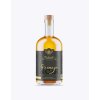



Polish semi-sweet mead aged for 6 months in oak barrels. Made from flower honeys with clearly noticeable oak tones, light, golden color, semi-sweet.
"Augustowski Jarní" mead is made from honey harvested in May and June, when the hives are filled with bright, aromatic honey from the nectar of wildflowers and sprawling linden trees. After more than a year of fermentation and clarification, this mead was stored in fresh Hungarian oak barrels for six months. Enjoy it slowly, because…
...good drinks are worth waiting for.
It won three silver medals at the Mazer CUP 2020, Mazer CUP 2021 and Mazer CUP 2022 competitions and a gold medal at the Orpheus Mead Festival 2021. It also won a bronze medal in the Best of Show competition at the Orpheus Mead Fest 2021. In 2022, it won another gold medal at the Orpheus Mead Festival 2022 and a bronze medal at the Valkyrie Horn Mead Competition 2025 USA.
mead
Mead is an alcoholic beverage fermented from honey and water, with possibility of addition of other ingredients such as spices or herbs or in combination with fruit juices.
Classical mead
Classical mead is made by fermenting honey and water without any other ingrediences. It keeps its original honey flavour and taste.
Type of honey
Blossom honey or nectar comes from the nectar of various flowers.
Mead are therefore spring flower honey.
Production process
This mead was boiled before fermentation. The thermal process has certain technological advantages, however, some valuable components of honey are damaged, especially during prolonged boiling. You will not recognize the production process in taste, but it is typical for boiled mead that they are more golden in color because honey partially caramelize at high temperatures.
Producer Augustowska Miodosytnia
Founders Piotr Piłasiewicz and Paweł Kotwica decided to reborn mead production in north-eastern Poland based on the traditions of the Polish-Lithuanian region. They come with interesting types of mead
Founders Piotr Piłasiewicz and Paweł Kotwica decided to restore the production of mead in north-eastern Poland, based on the traditions of this Polish-Lithuanian region. They come with interesting types of meads.
The idea of creating Augustowska Miodosytnia was born from our involvement in the revival of beekeeping and the willingness to share experiences with home mead production. As with beekeeping, honey production is a beautiful old Polish tradition, pushed out of the market and public awareness by the popularization of more economical forms of production. We opened Augustowska Miodosytnia to produce the highest quality mead in the traditional way, using only natural ingredients obtained from the Augustów forest and neighboring areas. We allocate part of the profits to the development of beekeeping by supporting the activities of the Bartne Brotherhood, from which we originate. Our mead recipes are derived from the rich tradition of mead production in the Polish-Lithuanian Commonwealth. We want to recreate the tastes that pleased our ancestors. According to this principle, we were the first in Poland to start the production of the forgotten Zbiceń.
The proper production of mead begins with dissolving the honey in the appropriate amount of water for the given recipe. It is then heated and cooked with spices and seasonings. This is how honey wort is produced, which is then pumped into a stainless steel fermentation tank, stirred intensively and, after cooling, yeast is added. After the first phase of fermentation, i.e. after approximately 3-12 weeks, depending on the type of honey (after the so-called turbulent fermentation), the honey goes into the next phase of production, during which it matures calmly, clears and acquires "character" over time. It takes 3 to 12 months. The honey is bottled when both laboratory tests and organoleptic tests confirm its correct "strength", as well as taste, color and aroma. Approximately 1,300 bottles of alcohol are produced in one production process. For example - we need a whole year to produce Trójniak. We don't want to speed up the natural processes because we know that good drinks are worth waiting for.